What It Means to See a Board-Certified Orthodontist

A board-certified orthodontist has gone beyond the education and licensing requirements necessary to practice orthodontics by voluntarily completing the certification process of the American Board of Orthodontics (ABO). The process requires orthodontists to demonstrate advanced knowledge and clinical expertise through a rigorous examination and certification process.

Dr. Wakas Abdulrazzaq is a board-certified orthodontist and Diplomate of the American Board of Orthodontics, bringing this additional level of professional distinction to patients in Riverview and throughout the greater Tampa Bay area.

Board certification reflects an orthodontist’s commitment to continued learning, clinical excellence, and maintaining the standards established by the ABO throughout their career.

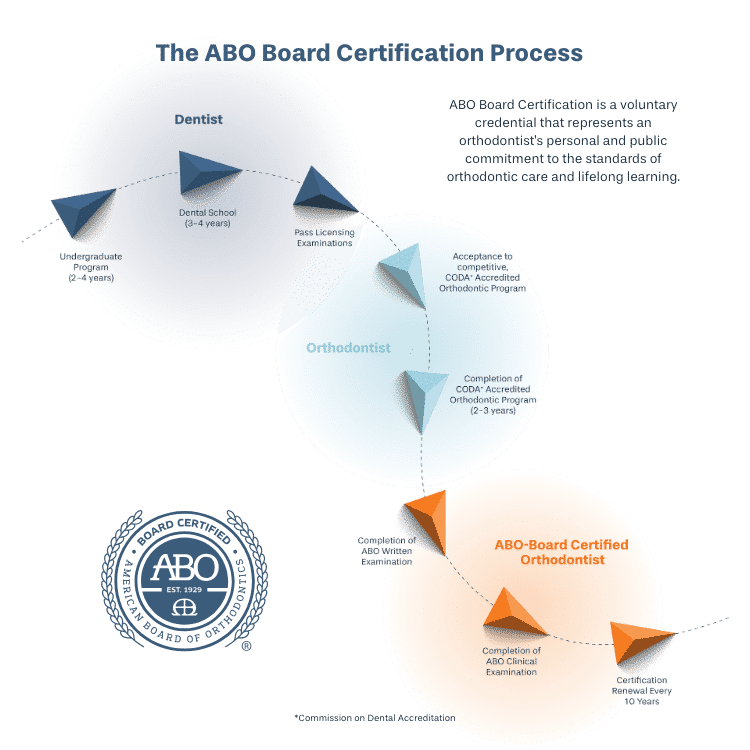
Diagram of the ABO Board Certification Process showing career steps from dental school to board certified orthodontist at Orthodontic Gallery in Riverview, FLLicensed Dentist, Orthodontic Specialist, and Board-Certified Orthodontist: What’s the Difference?

Licensed dentist.
Every practicing dentist must hold a state dental license. A licensed general dentist may provide many types of dental care, including orthodontic treatment. However, a dental license alone does not make a dentist an orthodontic specialist.

Orthodontic specialist.
An orthodontist first completes dental school and then an additional two to three years of full-time, accredited specialty training in orthodontics. This advanced training focuses on tooth movement, bite correction, facial growth and development, and the relationship between the teeth and jaws. It is this additional specialty training that distinguishes an orthodontist from a general dentist who provides orthodontic treatment.

Board-certified orthodontist.
Board certification is an additional voluntary credential beyond orthodontic specialty training. Certification through the American Board of Orthodontics (ABO) requires an orthodontist to demonstrate advanced knowledge and clinical expertise through a rigorous examination and certification process. Diplomates must also meet ongoing requirements to maintain their certification.

Founded in 1929, the American Board of Orthodontics is the oldest specialty board in dentistry. An orthodontist who successfully completes its certification process is recognized as a Diplomate of the American Board of Orthodontics.

Why It Is Worth Checking

Nothing about certification guarantees an outcome, and there are excellent orthodontists who never pursued it. What it does tell you is specific and verifiable: this orthodontist chose to have finished work judged by peers, and passed.

That matters more when you have no other way to evaluate someone. Board certification adds an independent check: examiners from the American Board of Orthodontics review an orthodontist’s finished cases. Certification is the only widely available signal that someone outside the practice has examined the actual work.

You can verify any orthodontist’s status yourself in the American Board of Orthodontics locator. It takes about a minute, and we would encourage you to check ours the same way you would check anyone else’s.

Dr. Wakas's Credentials

Dr. Wakas Abdulrazzaq is a Diplomate of the American Board of Orthodontics. He earned a Doctor of Dental Surgery (DDS) at the University of Jordan. He finished his orthodontic certificate in 2021 at Georgetown University/MedStar Washington Hospital Center, where he served as chief resident.

That residency included a weekly rotation at Children’s National Hospital in Washington, DC. The cases there were cleft and craniofacial patients, plus children with significant behavioral and sensory needs.

He is a member of the American Association of Orthodontists and the American Dental Association. Full background is on his bio page.

Questions About Board Certification

Every orthodontist has completed a residency in the specialty. A board-certified orthodontist has additionally passed the American Board of Orthodontics examination and had completed treated cases reviewed by a panel of examiners. Certification is optional, and fewer than a third of orthodontists hold it.
Use the orthodontist locator on the American Board of Orthodontics website and search by name or location. If a practice says “certified” but the doctor’s name is not in that database, ask what the word is referring to.
A general dentist can legally provide orthodontic treatment, and many do it well for straightforward cases. An orthodontist has spent two to three additional full-time years doing only this, which matters most when a case involves growth, jaw relationships, extractions, or anything that has already been treated once before.
No. Certification is a professional credential the orthodontist pursues at their own expense. It is not a fee added to treatment.

Meet a Board-Certified Orthodontist in Riverview

Consultations at The Orthodontic Gallery are free and include a full examination and a written plan. Call 813-867-0414 or request an appointment. We are at 10061 Beach Verbena Drive in Riverview, Florida.